Why Your Gutters Ripped Off the House This Winter
How ice dams and freeze-thaw cycles tear gutters off Minnesota and North Dakota homes, and what actually stops it.
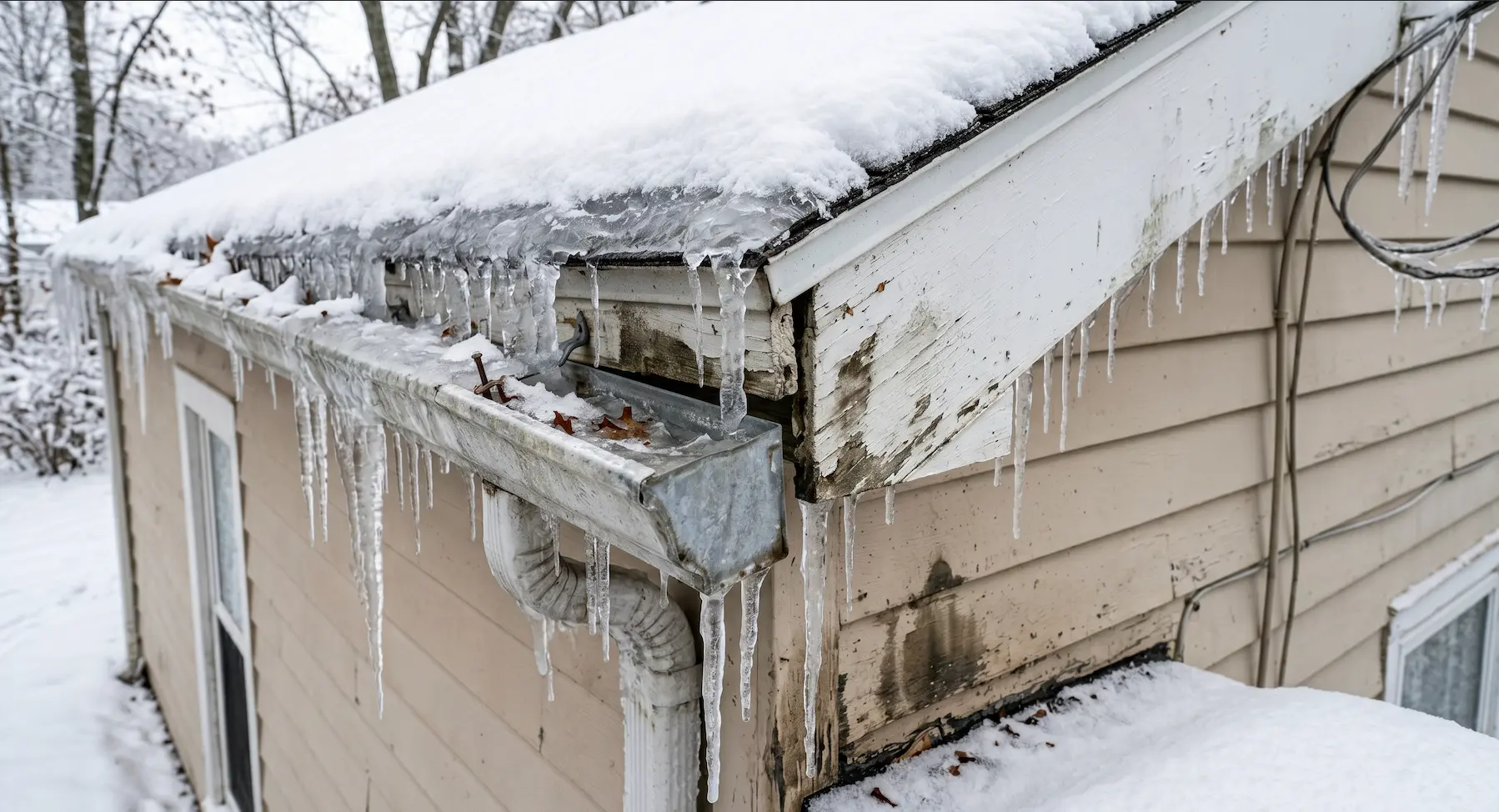
You walked out to grab the mail during that first warm Saturday in February and there it was: a twenty-foot run of aluminum hanging off the fascia like a broken arm, one end still bolted up, the other drooping into the juniper. If you live in Fargo, Bismarck, or anywhere in the Twin Cities metro, you are not alone. Every thaw week, our phone starts ringing before the snow is even off the driveway.
Here is what actually happened up there, and what you can do so it does not happen again.
The Mechanism Nobody Explains
A gutter does not rip off because aluminum is weak. It rips off because physics spent six weeks loading it up.
It starts in your attic. Warm air leaks up through can lights, bath fans, the attic hatch, and any gap in your ceiling plane. That warm air heats the underside of the roof deck. Snow on the upper two-thirds of your roof melts from below, trickles down under the snowpack, and hits the eave, which is cold because it hangs out past the heated envelope of the house. The water refreezes right there at the drip edge. Do that for a week and you have an ice dam. Do it for a month and you have a fifty-pound ridge of ice sitting in and on top of your gutter.
Now add the leverage problem. A frozen gutter is no longer a gutter. It is a continuous steel-hard beam glued to your roof. When the sun finally hits it and the ice sheet on the roof shifts even an inch, it drags the whole frozen mass with it. The gutter cannot flex. The fasteners can. Spikes pull out of the fascia like corks. Hidden hangers that were spaced 32 inches apart pop their screws. The run sags, then peels.
In Bismarck this past February we measured a stretch of ice on a ranch house in north-end that weighed, conservatively, over 300 pounds across a 24-foot gutter run. The gutter was rated for its own weight full of water. It was not rated for that.
Fix the Attic First
Before you spend a dime on new gutters, get in the attic with a flashlight. If you can see daylight at the soffit vents, good. If the insulation is compressed, thin, or you can see the tops of the ceiling joists, that is your problem. Most older Twin Cities houses we see are still running R-19 or R-30 when code wants R-49 or R-60. Air-seal the top plates and penetrations, then blow in more cellulose. Make sure soffit vents are clear and there is a real path from soffit to ridge. A cold attic means a cold roof, and a cold roof means the snow up there just sits there instead of becoming water that freezes at the edge.
This step matters more than anything we can sell you. And if meltwater is already finding its way into the basement, our guide on checking your gutters before calling a foundation company is the place to start.
Then Fix the Gutters
Once the ice-dam load is under control, the gutter itself can be built to survive a normal Minnesota winter.
A few things we do differently on replacement jobs in freeze country:
Heavier aluminum. Most off-the-shelf seamless gutter is .027 gauge. We run .032 as standard on anything north of I-94. The difference in rigidity is noticeable when you lean on it.
Tighter hanger spacing. Code minimum is often 32 inches. In snow country that is not enough. We run hidden hangers every 18 to 24 inches, and every 16 inches on long north-facing runs that collect the worst drifts. More hangers is more screws biting into the fascia, which is where the fight happens.
Hidden hangers with structural screws, not spikes. If you still have spike-and-ferrule gutters on your house, they are living on borrowed time. Spikes loosen every freeze cycle. A 2-inch structural screw driven through a hidden hanger into solid fascia is a completely different attachment.
Bigger downspouts, more of them. A 2x3 downspout on a 40-foot run is asking for trouble. We upsize to 3x4 and add a second drop so water actually leaves the gutter instead of sitting in it waiting to freeze.
Replace or Reattach?
Honest answer: if the gutter is only sagging in one spot and the aluminum is not kinked or torn, a rehang with new hangers is fine. Save your money. If the run is crinkled, the end caps popped, the miters split, or the fascia board behind it is rotted, you are past repair. At that point you are paying a crew to put lipstick on something that will fail again next February.
The tell is usually the fascia. Pull the gutter off and look at the wood. If it is black, soft, or you can push a screwdriver into it, the fascia needs to come off and get replaced before any new gutter goes up. Skipping that step is the single most common reason a "new" gutter fails within two years.
If you are trying to decide whether a run is worth saving, our post on 5 signs it is time to replace your old gutters covers the other warning signs to look for.
One More Season Like That
If you are staring at a bent gutter right now and wondering whether to duct-tape it through spring or handle it right, give us a call before the next freeze-thaw cycle. We will come out, look at the attic too, and tell you honestly whether you need a repair or a full replacement. Minnesota at (763) 292-4044, North Dakota at (701) 580-9991.