Your Gutters Are Overflowing Even Though You Just Cleaned Them. Here's What's Actually Wrong.
Five real reasons gutters overflow after a cleaning, and how to diagnose each in under 10 minutes.

You are standing on the porch in a June thunderstorm watching a waterfall pour over the front of the gutter you cleaned last weekend. You paid for the cleaning or you did it yourself, and the gutter is clearly empty at the back, because you can see it when the wind catches the sheet of water. Something else is wrong. Here are the five actual causes, in order of how often we find them.
1. The Downspout Is Clogged Deep Inside
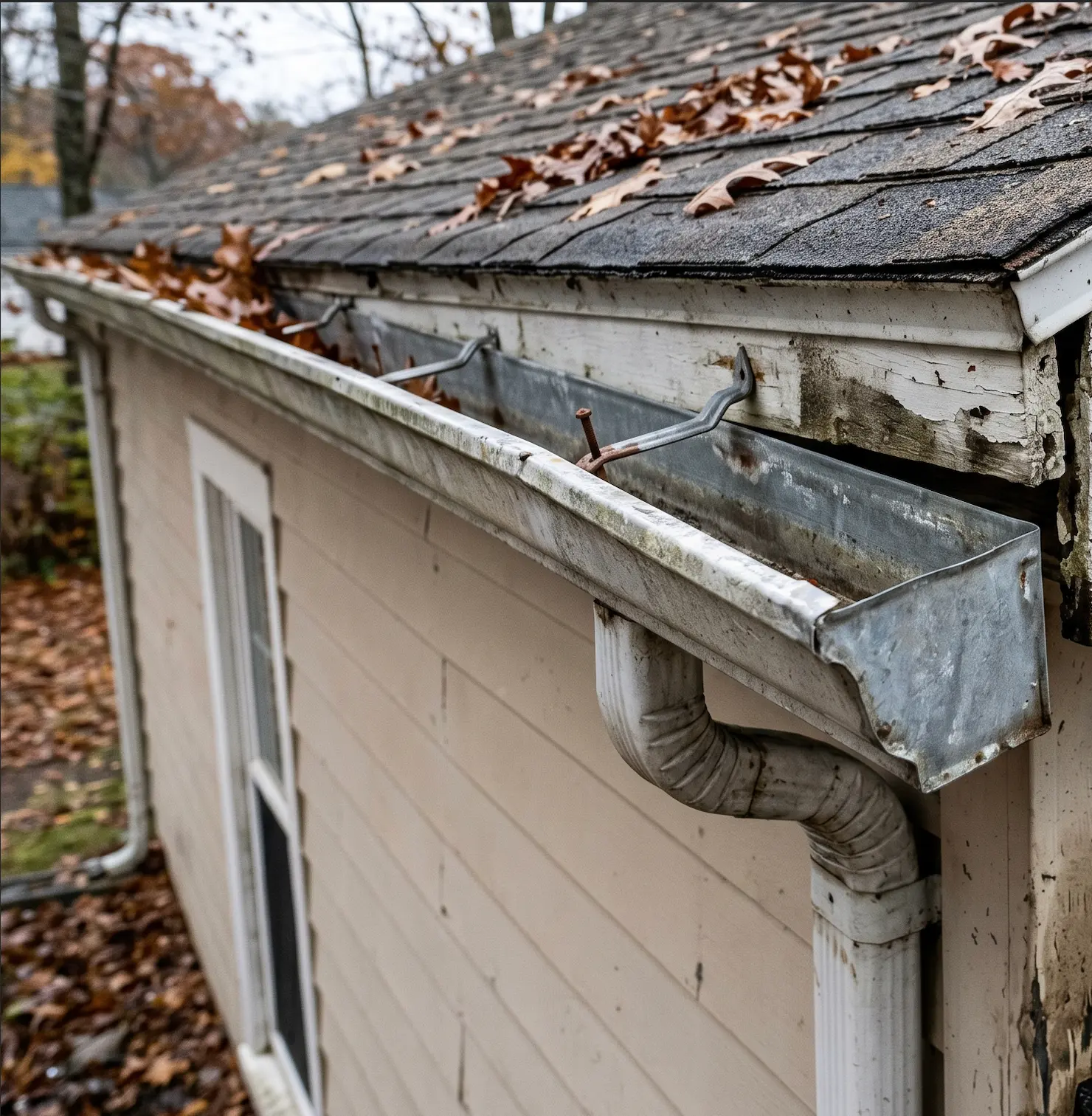
This is the most common one and the easiest to miss. The top of the gutter looks clean. The mouth of the downspout looks clean. But six feet down inside the downspout, at the elbow where it turns to head toward the ground, there is a wad of compacted needles, a tennis ball, or a rotted clump of maple keys from two springs ago. Water comes down the gutter, hits the elbow, cannot get past, and backs up until it sheets over the front edge.
How to check in 60 seconds: take a garden hose, stick it in the top of the downspout at the gutter, and turn it on. If water comes out the bottom at the same rate you put it in, the downspout is clear. If it backs up at the top, you found your clog. Sometimes you can knock it loose by tapping the downspout with the flat of your hand, starting at the top and working down. Listen for the hollow sound to change. Worst case, you take the elbow apart or run a plumbing snake down from the top.
2. The Pitch Is Wrong
Gutters need to fall toward the downspout at about 1/4 inch per 10 feet of run. Not much, but real. If the gutter is dead level, water pools in the middle instead of running out. If it is pitched the wrong way (toward the closed end) water collects at the wrong end and overflows there.
How to check: take a 4-foot level and set it on the front lip of the gutter. You should see a slight fall toward the downspout. No fall, or fall in the wrong direction, and you need the gutter rehung. This is also the one that spike-and-ferrule gutters drift out of over time, as the spikes loosen and the middle of the run sags. Rehanging is standard gutter repair work, and you can see the common fixes in our post on the top three gutter repairs every homeowner should know.
3. Not Enough Downspouts
Rule of thumb: one downspout per 30 to 40 feet of gutter, and every gutter run should have one at each end or a single one in the middle of a run that is under 40 feet. Long runs with a single corner downspout cannot keep up in a hard rain. The gutter fills because water is entering it faster than one 2x3 outlet can drain it.
How to check: pace off your gutter runs. A 60-foot run on one side of the house with a single 2x3 downspout at the far corner is undersized. You need a second drop, or you need to upsize to 3x4.
4. The Gutter Is Too Small for the Roof
A 5-inch K-style gutter handles most one-story houses in the Inland Northwest and the Upper Midwest fine. A steep two-story with a big roof feeding one section of gutter is another story. The water velocity off a 10/12 pitch roof is high enough that on a 5-inch gutter, the water can literally jump the front edge before it has a chance to settle in. This is more common with steep architectural rooflines and with homes that have a wide roof section draining to a short valley.
How to check: look at where the overflow happens. If it is only happening below a valley or below a steep section of roof, and only in heavy rain, and the downspout is clear and the pitch is right, you are probably under-sized. The fix is 6-inch K-style gutter with 3x4 downspouts, which is what we put on any steep two-story now.
5. Missing Kickout Flashing
This is the sneakiest one and it is the one that rots fascia boards and siding behind the gutter. Where a roof meets a wall (think a garage roof dying into the side of a two-story, or a dormer cheek wall), there should be a small angled piece of metal called a kickout flashing that redirects water off the roof edge and into the gutter. Without it, the water runs down the wall, behind the gutter, and either into the wall cavity or over the outside of the gutter in a concentrated stream.
How to check: find every place where a roof line ends against a vertical wall. Look for a small flared piece of flashing at the bottom of the roof edge, kicking water outward. If it is not there, add one. This is a shingle-cutting job best handled by a roofer, but it is a small fix that prevents a large rot problem.
Winter Is Different
One note: if your gutters are overflowing in February in Fargo, Bemidji, or Coeur d'Alene, none of the above is the answer. The downspout is frozen solid at the ground, or the gutter itself is packed with ice, and water is backing up over an ice dam. We wrote a full post on why winter gutters fail and how to stop it. The short version: do not try to chop ice out of a frozen gutter. You will destroy the gutter and probably yourself.
When to Call
If you walked through those five checks and cannot figure out which one it is, we will come look. Bring a rain jacket, because the best time to diagnose overflow is during an actual rainstorm, which is when we like to show up anyway. Timing matters for prevention too, which is why we wrote about the best time of year to clean your gutters. MN (763) 292-4044, ND (701) 580-9991, ID and Eastern WA (208) 675-9991.